|
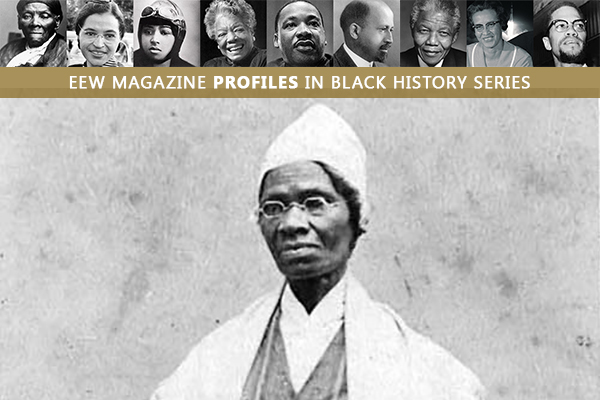
EEW Magazine Profiles In Black History Series: Sojourner
Truth
|
|
|
|
 |
|
|
|
|
|
|
|
Sojourner Truth was born into slavery under her original name Isabella Baumfree circa 1797, in the
town of Swartekill, in Ulster County, New York as one of twelve children.
After the death of her first owner, 9-year-old Truth was sold at an auction with a flock of sheep for
$100. After being sold from owner to owner twice more over the ensuing two years, Truth came to
reside on the property of John Dumont at West Park, New York. It was during this time that she
learned to speak English, having previously only spoken Dutch.
After Dumont went back on a promise to free Truth in late 1826, she escaped to freedom with her
infant daughter, Sofia.
Shortly after her escape, Truth learned that her 5-year-old son Peter, whom she’d left behind, had
been illegally sold to a man in Alabama, and took the issue to court. She secured her son’s return,
thus becoming the first black woman to successfully challenge a white man in a United States court.
On June 1, 1843, she officially changed her name from Isabella Baumfree name to Sojourner Truth,
and devoted her life to the abolition of slavery, and women’s rights.
In May of 1851, Truth delivered a speech at the Ohio Women’s Rights Convention in Akron. The
speech became known as “Ain’t I a Woman?”
The first written version of the speech, published a month later, did not include the question “ain’t I
a woman?” even once. The famous phrase emerged in print 12 years later, as the refrain of a
Southern-tinged version of the same speech. It is unlikely that Truth, a native of New York whose
first language was Dutch, would have spoken in this Southern dialect.
During the Civil War, Truth helped recruit black troops for the Union Army, and in 1864, she met
President Abraham Lincoln. Truth fought vehemently for African American’s rights, and attempted
to force the desegregation of streetcars in Washington in 1865, by riding in cars designated for
whites.
In 1870, Truth tried to secure land grants from the federal government for former slaves, a project
she pursued passionately for seven years without success.
Though she started her career as an abolitionist, the reform causes she spoke out about were
broad and varied, ranging from prison reform to voting rights for all individuals, regardless of race
or gender.
In 1883, on November 16, Sojourner Truth died at her home in Battle Creek, Michigan.
In 1981, Truth was inducted into the National Women’s Hall of Fame in Seneca Falls, and in 2014
was included in Smithsonian Magazine’s list of the “100 Most Significant Americans of All Time.”
|
|
|
|
|